












Somebody mentions a washing machine out loud. Two hours later, washing machine ads all over Instagram. And the room instantly splits, half certain the phone is listening, half calling it coincidence. Nobody changes their mind.
The real answer sits in between, and it's far more useful than either camp.
Short answer: your earbuds are listening for a wake word, but they aren't recording and uploading everything you say. The genuine risk isn't surveillance. It's false wakes, over-permissioned companion apps, and cheap devices with no privacy policy or firmware updates. Most of it is fixable in about ten minutes of settings.
Are earbuds always recording you?
No, and the way it actually works is worth understanding.
A wake-word system keeps a tiny loop of audio in memory on the device itself. Couple of seconds, constantly overwritten, going nowhere. A very small model scans that loop for one specific pattern, the "hey" whatever, and everything else is discarded before it exists anywhere permanent.
Pattern matches, things wake up. Recording begins properly, and depending on the product the device either handles the command locally or sends audio to a server, gets a response, plays it back.
What is not happening is a continuous stream of your entire life going to a data centre. Forget privacy for a second, the bandwidth alone would be absurd, and so would the storage bill.
The real leak: false wakes
Wake-word detection isn't precise. It fires on TV dialogue. On a name that sounds vaguely close. On random noise in a crowded room.
When it fires wrongly, the device does exactly what it was designed to do. It starts recording and sends that audio onward. Nobody said the wake word. The system just decided somebody did.
That's the actual point of leakage. Not surveillance. Accidents, a few times a week, on a device sitting in your ear all day.
The 2019 incident that changed defaults
Around 2019 it emerged that voice assistant recordings were being reviewed by human contractors. Real people listening to clips, grading whether the assistant had understood correctly.
That part is standard machine learning practice. Models need labelled data, someone has to label it.
The problem was that some clips came from false wakes. So contractors occasionally sat listening to fragments of private conversations. Medical discussions. Arguments. Moments never meant to be a command to anything.
Companies apologised and made human review opt-in rather than automatic. Apple later settled a long-running Siri lawsuit over this while denying wrongdoing. Most large players have genuinely improved since.
But "most large players" is carrying weight in that sentence, because a huge share of earbuds sold in India aren't made by large players at all.
Why voice data is more sensitive than step counts
If a fitness band leaks that you walked 6,000 steps on a Tuesday, that's not great, but it isn't serious.
Voice is a different category entirely.
Voice is biometric. It identifies you the way a fingerprint does, and unlike a password, you cannot change it after a breach.
Recordings carry more than words. Age, gender, region, emotional state, sometimes health signals, all of it comes through in how a person speaks.
The transcript is often the more sensitive half. That's where your queries live, and a list of someone's queries is essentially a record of what they were thinking about that week.
This matters more now than three years ago, because earbuds are shifting from devices that occasionally catch a command to devices designed to be talked with. That means the volume of voice interaction per person goes up sharply.
How does boAt Crest AI handle voice data?
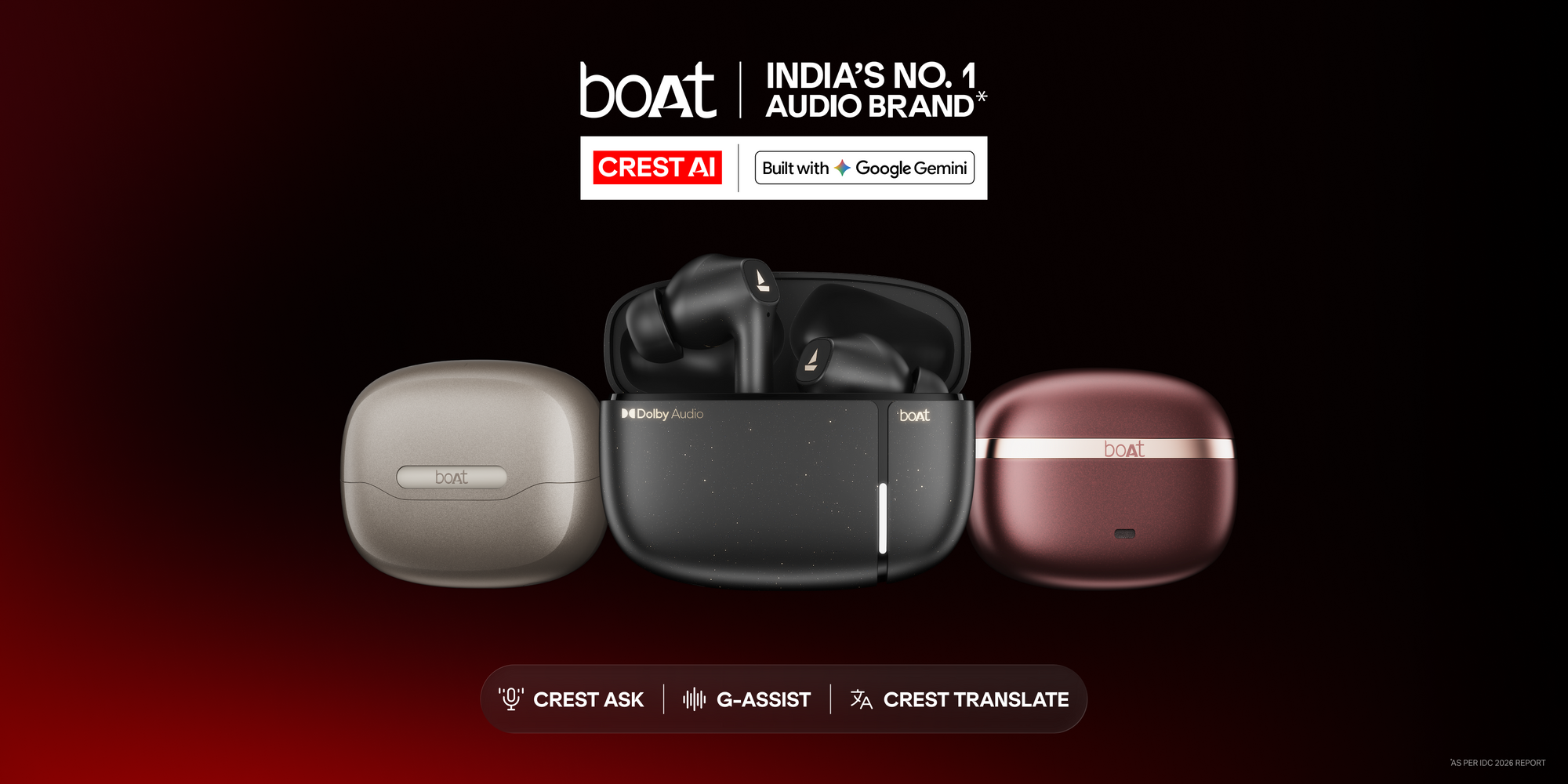
Crest AI is boAt's AI platform for its next generation of earbuds and headphones. A few details matter specifically for a privacy conversation:
It's cloud-based. Crest AI runs on Google Gemini, with Google Cloud handling speech processing. So audio is going to a cloud service to be processed, same as most assistants. The conversational features need an active internet connection on your paired phone, and currently Android 12 or above. Basic playback controls still run locally.
It listens in English only at launch, including Indian and other English accents. There's a translate function for output, but the listening side is English for now.
boAt's stated data position: voice data is encrypted in transit and processed based on user consent, used to deliver the feature you requested rather than sold on for third-party advertising.
That's a reasonable baseline, and worth stating plainly. It is not "zero data sharing," and any brand claiming that about a cloud-based assistant is stretching things. Cloud processing means data moves. The useful questions were never whether it moves, but who handles it, how long it sits there, and whether you can delete it.
One genuine upside of a homegrown brand building this layer: the company you'd escalate to operates under Indian law. As the DPDP framework takes full effect, that's an easier entity to hold to a standard than a chain of foreign vendors nobody can trace. The homework stays the same. At least the address is local.
The companion app is usually the bigger risk
Everyone worries about the earbuds. Almost nobody checks the app. That's backwards.
Look at what permissions your earbud app has requested. Many want location, justified as necessary for Bluetooth scanning, which on Android is technically true. Some want contacts. Some want storage. Plenty bundle third-party analytics SDKs quietly reporting usage back to whoever wrote them.
The earbud is a limited device with a small chip. The app is a full application on a phone holding your entire digital life. Between those two, it's not hard to work out which one a data broker actually wants.
Cheap unbranded earbuds are a different risk profile
With a ₹899 pair off a marketplace, you often get:
-
No clear sense of where data goes
-
No privacy policy, or one copy-pasted with another company's name still in it
-
Servers in jurisdictions never disclosed
-
No firmware updates ever, meaning any security hole found later stays open permanently
That's the honest risk profile, and it has almost nothing to do with anyone deliberately spying on you.
Where Indian law stands: the DPDP Act
The Digital Personal Data Protection Act passed in 2023. The rules under it were notified in November 2025, which is when it stopped being a document and gained actual machinery. The Data Protection Board now exists. Rollout is phased over roughly eighteen months, with most heavier company obligations landing around May 2027.
The direction is good. Consent has to be specific. You get a right to deletion. Companies must disclose what they collect and why.
For now though, if you're buying earbuds today, you're still largely relying on a company's own policy rather than an enforced legal standard.
What to actually do about it (10 minutes)
-
Check your voice history. Open assistant settings on your phone and find the list of past recordings. Read a few. The false wakes jump right out, fragments of conversation that were obviously never a command. Delete them.
-
Turn on auto-delete. Three months, where the option exists.
-
Switch off "improve the product using recordings." It's on by default nearly everywhere and turning it off costs you nothing noticeable.
-
Disable the wake word if you don't use it. Touch controls keep the mic out of listening mode entirely.
-
Audit app permissions. Strip anything that makes no sense. Two minutes.
-
Before buying, check two things: does the company maintain a real privacy policy, and does it still push firmware updates for older models. That second point says more about how seriously a brand takes security than any marketing claim.
-
Find where voice interactions are stored. On a device meant to be spoken to all day, that setting should be easy to locate. When it is, that usually says something good about everything else.
The honest takeaway
None of this deserves panic. The realistic risk was never someone sitting in a room listening to you.
It's the boring stuff. Profile-building for ads. Data sitting on a server longer than necessary. A breach five years from now at a company whose product you've long since thrown in a drawer.
Boring risks are still risks. They just respond very well to boring fixes. Ten minutes in your settings, and some thought about which brand gets that data in the first place.
FAQ
Are my earbuds recording everything I say? No. Wake-word detection keeps a couple of seconds of audio in a loop on the device, constantly overwritten, and only records properly once the wake word triggers. The real leak is false wakes, when the system mistakenly thinks it heard it.
What is a false wake and why does it matter? When wake-word detection fires by mistake, on TV dialogue or a similar-sounding name, the device records and sends audio you never intended to share. This is how private conversation fragments ended up in human review datasets in 2019.
Does boAt Crest AI process voice on the device or in the cloud? In the cloud. Crest AI runs on Google Gemini with Google Cloud handling speech processing, so conversational features need an active internet connection. Basic playback controls run locally.
What does boAt say about voice data? That it's encrypted in transit and processed with user consent, used only to deliver the requested feature rather than sold for third-party advertising. Worth reading the full policy in the app.
Is any cloud assistant truly "zero data sharing"? No, and be suspicious of any brand claiming it. Cloud processing means audio leaves the device by definition. The real questions are who handles it, how long it's retained, and whether you can delete it.
Which languages does Crest AI listen in? English only at launch, including Indian and other English accents. It can translate phrases into other languages as output, but it isn't listening in Hindi yet.
How do I delete my voice recordings? Open assistant settings on your phone, find voice or activity history, and delete. Most platforms also offer auto-delete after three months. Do the same inside the earbud brand's own app.
Should I worry more about the earbuds or the app? The app, almost always. It's a full application on a phone holding your entire digital life, often requesting location, contacts or storage. The earbud is a small chip with limited access.
What is the DPDP Act and does it protect me yet? The Digital Personal Data Protection Act passed in 2023, with rules notified in November 2025. It requires specific consent, disclosure, and gives deletion rights. Rollout is phased, with heavier company obligations landing around May 2027, so for now you're leaning largely on each brand's own policy.
Are cheap unbranded earbuds a privacy risk? Generally yes, not because anyone is spying on you, but because they often lack a real privacy policy, don't disclose server locations, and never push firmware updates, so security gaps found later stay open indefinitely.