











Go find your old wired earphones. You know the ones, the white ones that came free with a phone years ago, cable gone slightly yellow near the jack, one ear a touch softer than the other. Plug them in. You're expecting to laugh at how dated they sound.
They won't sound dated. They'll sound fine. Not amazing, just fine.
What actually stands out is how differently they behave compared to whatever's in your ears right now. They just play. Whatever's in the file comes out of the driver. Done. No app to open, no firmware update nagging you, no chime telling you it's "connected."
That gap, that one difference, is basically this whole article.
One tuning, shipped to everybody
For close to a century, audio worked one way, and honestly, it worked fine.
Somewhere, a team of engineers sat in a treated room with measurement rigs and decided how a pair of headphones should sound. They argued over the bass, settled on a curve, and that exact curve went into every single unit that left the factory. Same tuning for a 19-year-old in a hostel and a 55-year-old boarding a flight. Same tuning whether your ear canal is wide or your left ear never quite seals properly.
The device had no idea where it was. No idea who was wearing it. No idea what was happening around it. It couldn't know, there was nothing in there to know with. That's not really a flaw, it's just how the economics worked back then. But it does mean every traditional headphone is a compromise, tuned for an "average listener" who, if you think about it, doesn't actually exist.
The device started deciding, continuously
Here's the thing people get wrong about AI earbuds: it's not that they always sound better. Sometimes they do. Sometimes a ₹1,500 wired pair will still beat them on pure sound. The real shift isn't quality, it's who's making the decision, and when.
Earlier, the tuning decision got made once, in a lab, and shipped frozen. Now it's happening in your ear, every few milliseconds.
Take noise cancellation. Old ANC ran on a single fixed profile. Great on a flight, since plane noise is basically one long predictable drone. Pretty useless in a sabzi mandi, in traffic, or when the flat above starts drilling at 9 am on a Sunday. Adaptive ANC samples what's actually around you, figures out what kind of noise it's dealing with, and reshapes the cancellation to match. Traffic rumble needs different handling than your colleague's loud mechanical keyboard, and a fixed profile can only ever be tuned for one of those.
Fit matters more than people give it credit for, too. Half the "my ANC is weak" complaints aren't really about the ANC. They're about a bad seal. Newer buds actually measure what's reaching your eardrum and adjust for it, which sounds like a small thing until you realise it fixes a problem most people didn't know they had.
Calls are where this gets obvious fast. Older mic noise reduction worked like a blunt gate: below a certain volume, just mute it. Which is exactly why the person on the other end kept hearing you cut in and out mid-sentence. Newer systems separate your voice from everything else happening around you, and on the better ones, a small sensor picks up jaw vibration so the earbud knows it's actually you talking, not the auto honking outside. Anyone who's taken an office call from inside a moving cab in this country knows precisely why this matters.
Then there's personalisation. Some earbuds now run a short hearing test, work out which frequencies you're weaker on, and adjust playback for you specifically. Makes sense, hearing genuinely changes with age and exposure, and no factory setting from 2019 accounted for that. Spatial audio with head tracking sits in this same bucket, though if we're being honest, it's still more of a party trick than something you'll use daily.
From earbud to something closer to a companion
Adaptive ANC was step one. Personalisation was step two. Step three is already here: the earbud stops being just something you listen through and starts being something you actually talk to.
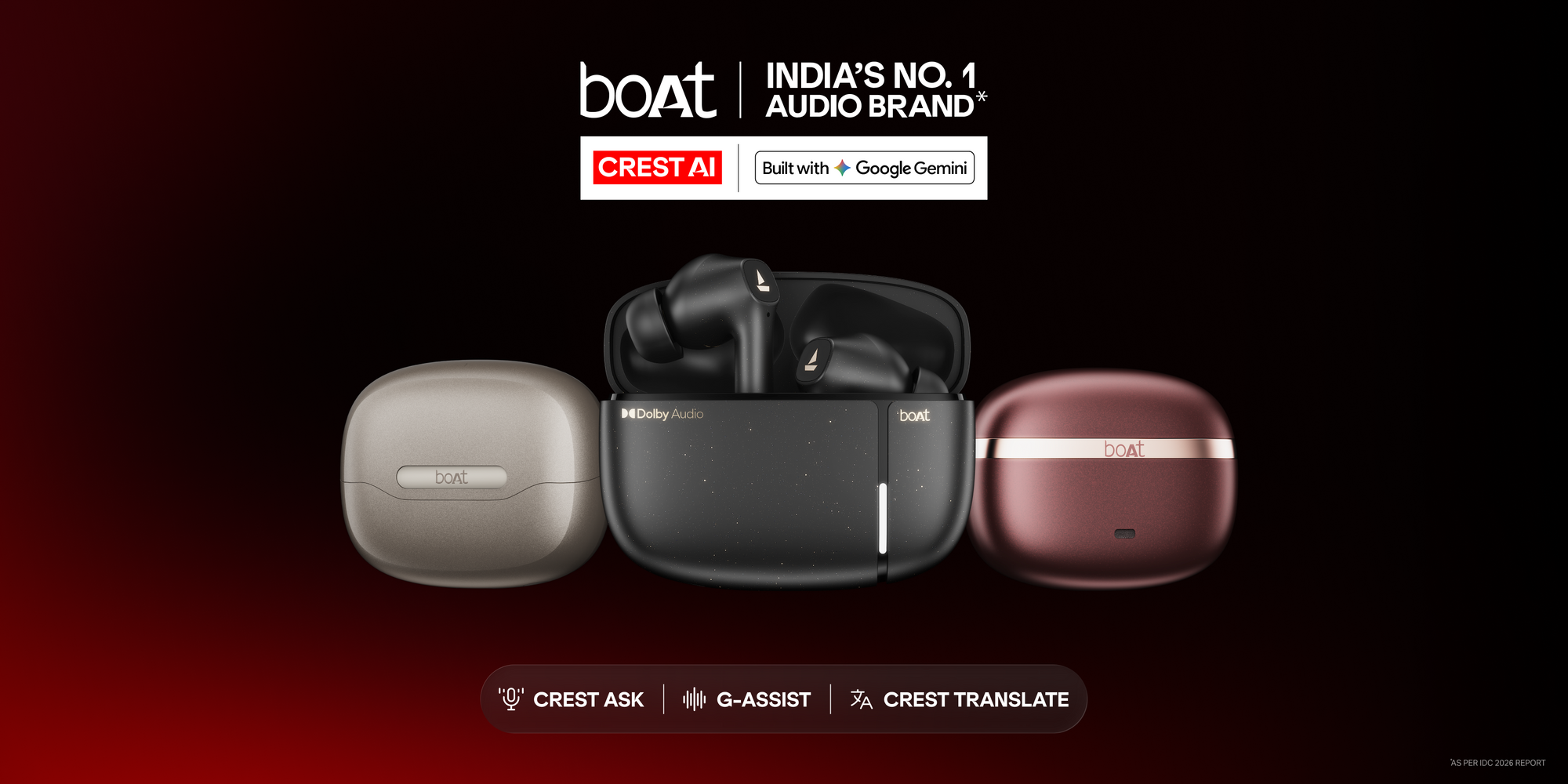
boAt's Crest AI is a good example of exactly this shift. It's boAt's own AI platform, built for its next generation of earbuds and headphones, running on Google Gemini with Google Cloud handling the real-time speech processing behind it. The pitch is simple: your earbud stops being a passive pipe between your phone and your ear, and becomes something you can actually speak to. Ask something mid-commute, get a real answer, get a phrase translated, get help without pulling the phone out for the tenth time that hour. The whole point is that it should feel like a conversation, not a list of commands, so you can interrupt it, follow up, change the topic, and it keeps up.
Now, here's the part worth being straight about, because it's the part that matters most for this market. At launch, Crest AI's speech recognition works in English only, including Indian and other English accents. It doesn't yet follow the kind of sentence most of us actually speak, Hindi sliding into English sliding into a regional word, in one breath. There's a translate feature, so you can ask it to give you a phrase in Hindi, but it's still listening to you in English. Full multi-language support is clearly where this is headed. It's just not there on day one, and it's worth knowing that before you assume it'll follow your Hinglish the way a friend would.
Two more practical things before you get excited: Crest AI needs an active internet connection on your paired phone, no offline mode here, and right now it only works on Android 12 and above.
What boAt is really trying to do is combine hardware, software and AI into one thing, and push earbuds from "device for music and calls" into "always-on AI companion you happen to wear." Whether that fully works out is a two-year question, not a today question. But logically, it tracks. Once the earbud is already sensing, adjusting and processing constantly, letting you actually talk to it is the obvious next move, not some big leap.
Same honest caveat that applies to everything else here: a companion's only as good as it is reliable, and it'll carry the same battery, app and data trade-offs as anything else on this list. Still, an AI you wear instead of one you hold in your hand is not a small idea.
What hasn't changed, at all
This is usually the part marketing conveniently skips.
Drivers are still drivers. The transducer, the acoustic chamber, how the tip actually fits your ear, these still decide the ceiling on how good anything can sound. No amount of software fixes a bad driver. It can smooth things out. It cannot invent detail that was never captured in the first place.
Wired still wins on latency, and on never needing a charge. If you're editing video or gaming, wireless is still a compromise, low-latency mode or not. A wired pair from ten years ago still works today, and will still work in ten more years. A smart earbud is a tiny computer strapped to a battery, and realistically, it's degraded by year three and abandoned by the company by year five. Nobody really questions that trade-off enough.
There's also a fair purist argument here. Every layer of processing is, technically, a decision about how music should sound, made after the artist and the mixing engineer already made theirs. If you actually care about hearing the recording as it was made, more intelligence isn't automatically a good thing. Sometimes it's just interference wearing a nicer name.
The trade-offs nobody puts on the box
Battery, first. Constant listening and processing eats power, and adaptive ANC drains faster than the fixed kind ever did. An always-on voice companion is, by definition, always drawing something. And those "40 hours playback" numbers on the box? Usually measured with everything switched off.
App dependence is real too. Old headphones needed nothing. New ones need an app, sometimes a login, and firmware updates that occasionally break something before fixing it. The company stops supporting a model, certain features just quietly vanish.
And then, data. A device with mics that's constantly reading your environment, and now one you're actively talking to, is by definition collecting something about that environment and that conversation. Worth actually checking what leaves the earbud and what stays local. boAt's line here is that voice and health data get encrypted in transit and are processed based on your consent, used to deliver the feature you asked for, not sold off for third-party ads. Reasonable enough as a policy. Still worth reading the actual privacy page yourself rather than taking any brand's word for it, including this one.
So, which one should you actually buy
If you're commuting, taking calls in noisy places, or bouncing between different environments through the day, adaptive features earn their keep fast, you'll notice the difference within a week. And if a hands-free AI companion sounds useful to you, asking questions, getting things translated, getting stuff done while your hands are on the bike handlebars, platforms like Crest AI are worth keeping an eye on. Just don't expect it to switch between Hindi and English mid-sentence yet. That's roadmap talk, not today talk.
If you mostly listen in one quiet room, a solid traditional pair at the same price will very likely sound better, simply because that budget went into the driver instead of chips, mics and a battery. Real trade-off, rarely advertised.
Truth is, for most people, both have a place. One pair that adapts and talks back and keeps pace with your day outside. One pair that just plays, for when you actually want to sit down and listen.
Which brings us right back to those old white earphones in your drawer. They're not better, not really. But there's something to be said for a device with exactly one opinion about how something should sound, and zero interest in changing its mind.
FAQ: boAt Crest AI on earbuds and headphones
What is Crest AI, in one line? boAt's own AI platform for its earbuds, headphones and connected wearables, built on Google Gemini and running on Google Cloud, designed to turn your earbuds into something you can actually talk to.
Does Crest AI work without internet? No. It needs an active internet connection on your paired phone. There's no offline mode for the voice or AI features.
Which phones support it? Android 12 and above, for now.
Does it understand Hindi or other Indian languages? Not at launch. Speech recognition currently works in English only, Indian and other English accents included. It can translate a phrase into Hindi as output if you ask, but the listening side is English-only for now.
What can you actually say to it? Ask about the weather before stepping out, get a quick workout, set a reminder, get a phrase translated, or ask what your SpO2 reading actually means in plain language. It's built for back-and-forth, so you can interrupt or follow up instead of firing off one command at a time.
Can it track my HRV, SpO2 or stress levels? No, that data comes from your device's own sensors. Crest AI can explain a reading in simple terms if you ask, but it's not the one measuring it.
Is my voice data shared with anyone? boAt says voice and health data are encrypted in transit and processed with your consent, used only to deliver the feature you requested, not sold for third-party advertising. Not quite "zero data sharing" since some processing does happen on the cloud, but worth reading the full privacy policy if that matters to you.
Does Crest AI only live in earbuds, or is it on smartwatches too? Both. The same Gemini Live experience can be triggered from a boAt smartwatch as well, streamed through the boAt app for processing.